





What Your Bathroom Shelf Can Tell You About Beauty Packaging
Take a quick look at the products beside your bathroom mirror. There might be a glass serum bottle, a plastic shampoo container, a metal deodorant spray, and a moisturiser that looks far too attractive to hide in a cupboard.
Most of us choose these products for what is inside them. Yet the packaging quietly influences how we use them, how well their contents are protected and what happens when they are empty.
One material worth a closer look is aluminium. Commonly associated with drinks cans and deodorant sprays, it also appears in bottles for skincare, haircare and other personal care products. Its appeal is easy to understand, although the practical differences between aluminium packaging formats are more interesting than their shiny appearance.
Why Some Beauty Products Come in Metal Bottles
Think about the products you reach for every morning. A facial toner needs a convenient dispenser, a hair treatment should be easy to handle with wet hands, and a travel-sized lotion needs a closure that stays secure inside a bag.
These everyday requirements help explain why packaging materials and shapes vary so widely.
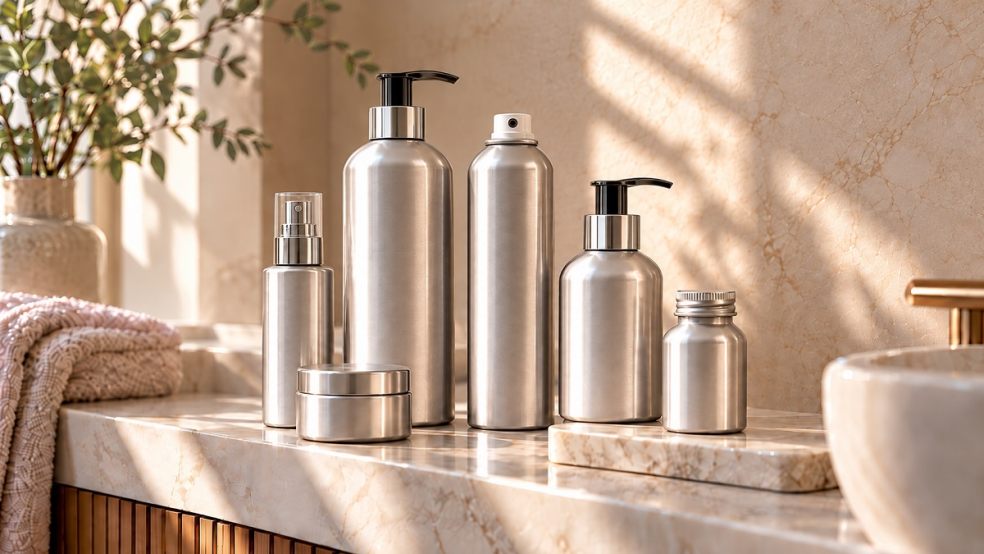
Aluminium bottles offer a lightweight alternative to glass and an opaque container that blocks light passing through its walls. The latter can be useful for formulations containing light-sensitive ingredients, although the bottle alone cannot guarantee that a skincare product will remain stable.
An internal protective coating may be necessary to keep the contents from reacting with the metal. The right coating is determined by the formulation rather than the appearance of the bottle.
There is also a simple aesthetic attraction. Aluminium can be decorated with colours, printed designs and finishes ranging from polished to matte, making it suitable for both understated and more colourful product ranges.
The result is packaging that can feel distinctive without requiring an elaborate shape.
A Fine Mist and an Aerosol Are Not the Same Thing
Here is something easy to miss when shopping for beauty products: two sprays that look almost identical may work in completely different ways.
A facial mist with a finger-operated pump generally uses mechanical action to dispense the liquid. It does not need the same kind of pressurised container as a conventional aerosol.
A deodorant spray or hairspray in a pressurised aerosol can operates differently. The container, valve and dispensing system are designed to work together under pressure.
That difference helps determine the product's spray characteristics, how it is filled and how the container must be manufactured.
Aluminium aerosol cans are typically made as seamless, one-piece containers, with a valve assembly fitted at the opening. They can be used for various personal care applications, including certain deodorants, hairsprays and shaving products.
Not every spray product needs an aerosol, however. A simple pump can be more suitable when the formula and desired application allow it.
Neither format is automatically better. A continuous hair styling spray and a targeted facial mist have different jobs to do, even if both sit on the same bathroom shelf.
The Details You Cannot See on the Label
The outside of a beauty container tells only part of the story.
A manufacturer working with aluminium packaging has to consider its opening size, closure arrangement, internal coating and intended filling method. With aerosol products, the valve and pressure requirements introduce another layer of complexity.
Shining Packaging, which manufactures aluminium aerosol cans and aluminium screw bottles, provides a useful illustration of this distinction. Its aerosol range includes different container diameters, opening configurations and internal coating options, while its screw bottles are available with different neck threads and closures.
These specifications are more than manufacturing details. They influence whether a particular dispenser fits, how the product is delivered and which formulations can be accommodated.
For a beauty business developing a new product, it makes sense to establish the formula and intended dispensing experience before settling on a container. Samples should then be tested with the actual contents and closure system, rather than assuming that a material suitable for one cosmetic product will work with another.
Consumers rarely see these decisions, but they experience the results whenever a pump dispenses smoothly, or a spray produces the intended finish.
The Recycling Question Is More Useful Than a Green Label
Aluminium has a valuable characteristic: it can be recycled without the metal itself losing its fundamental material properties.
That does not mean every aluminium beauty product is automatically an environmentally superior choice.
The complete package may include plastic caps, pumps, valves or other components. Manufacturing and transport also have environmental impacts, while recycling depends on whether used containers enter an appropriate collection system.
In the UK, empty aerosol cans can be recycled through suitable collection services. The guidance from Recycle Now is straightforward: make sure the can is empty, remove loose or easily detachable parts as directed, and never pierce, crush or flatten it. Local collection instructions should still be checked.
It is equally worth questioning broad claims about refillability. A container is only a practical refill option when its design, closure and intended use support repeated filling, and an appropriate refill system is available.
Rather than relying on packaging described simply as 'green', shoppers can look for specific information about materials, disposal and reuse.
What Deserves Space on Your Bathroom Shelf?
There is no need to become a packaging expert to make more informed choices.
Notice whether a dispenser gives you the amount you need, whether the container is comfortable to hold and whether the packaging provides clear instructions for disposal. A beautiful bottle that regularly leaks into a washbag is hardly a triumph of design.
The same thinking applies to those increasingly attractive beauty products we are tempted to leave on display. Appearance is part of the experience, but convenience and reliable performance are what make a product pleasant to use every day.
Aluminium bottles and aerosol cans offer different ways to balance those qualities. Understanding the difference makes it easier to look beyond the colour, finish or sustainability slogan.
The next time you finish a moisturiser, hairspray or facial mist, take a second look at the container before throwing it away. There is more thought behind that ordinary bathroom object than its label is likely to reveal.