






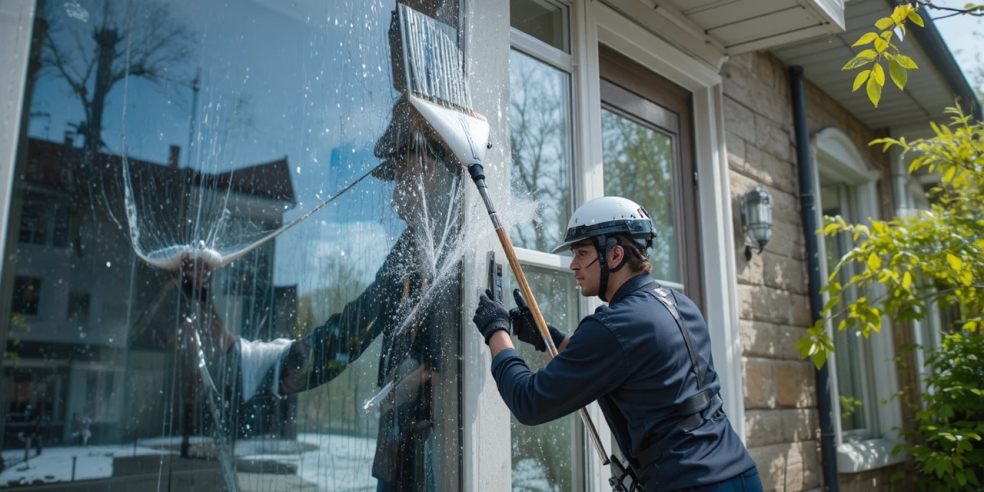
No, a Bit of Rain Won't Undo Your Window Clean
It's one of the most common things window cleaners hear. The job's done, the glass is spotless, and within a day or two, the customer looks outside and sees rain falling. Cue the sinking feeling. Cue the message asking whether they should have waited.
The short answer is no. The longer answer is worth understanding properly, because the assumption that rain ruins a fresh window clean is not only wrong, it's costing people money and leaving their windows in worse condition than they need to be.
Where the Myth Comes From
It's not an unreasonable assumption on the surface. Rain looks dirty. It falls through polluted air, picks up dust and debris, and lands on everything, including the glass you've just paid to have cleaned. So it stands to reason that rain would undo the work.
But here's the thing. Rain itself is not dirty. It starts as evaporated water vapour distilled, in effect, before it condenses into droplets and falls. What makes rain look dirty on windows isn't the rain. It's what was already on the glass before the rain hit.
If your windows are genuinely clean, properly clean, down to the glass surface, rain has very little to deposit. The marks you see after a rainfall on recently cleaned windows are almost always one of two things: residue that wasn't fully removed in the first place, or airborne particles that settled on the glass after the clean and then got disturbed by rain.
Neither of those is the rain's fault.
What Pure Water Cleaning Actually Does
This is where the science matters, and it's simpler than it sounds.
Professional window cleaners like Simply Cleaning Services use a pure water system filter out all dissolved minerals before the water ever touches your glass. The total dissolved solids, the measurement of mineral content, is brought down from 200mg/L or more in hard water areas like Norfolk, down to effectively zero. Single digits, ideally below five.
When that water dries on your glass, there is nothing left behind. No calcium. No magnesium. No residue. Just clean the glass.
Now compare that to what happens when rain dries on a window. Rainwater falling through the atmosphere picks up particulate dust, pollen, and pollution on its way down. When it lands on a clean surface and evaporates, it can leave a faint film of whatever it collected in the air. On a genuinely clean window, this is minimal. On a window that still has a layer of grime, grease, or mineral scale from inadequate cleaning, it shows up dramatically.
The difference isn't the rain. It's the starting condition of the glass.
Rain on a Properly Cleaned Window
Think about what actually happens when rain hits a properly cleaned pane. The water beads, runs, and drains. It doesn't cling in the same way it does on a dirty or scaled surface.
Clean glass is smoother at a microscopic level. There are no rough mineral deposits, no greasy film, no patches of embedded dirt for water to catch on. So rain runs off more cleanly and dries more cleanly, leaving far less visible residue than it would on a neglected window.
There's a reason car detailers talk about glass coatings and hydrophobic treatments to improve water run-off. The underlying principle is the same. A clean, smooth surface sheds water better. A dirty, rough surface holds onto it.
So strangely, a properly cleaned window actually handles rain better than a dirty one.
The Situations Where Rain Does Cause Problems
To be fair about it, rain can cause visible marking in certain conditions. But it's worth being specific about when and why.
Heavy rain following a dry, dusty spell is probably the most common culprit. When windows haven't been cleaned for weeks or months, dust and pollen settle on the glass in dry weather. When heavy rain finally arrives, it disturbs that layer and redistributes it rather than washing it cleanly away. The result looks like rain damage. Really, it's the pre-existing dirt being rearranged.
Nearby building work or roadworks create elevated levels of particulate matter in the air. Cement dust, sand, and fine debris settle on everything, including freshly cleaned glass. When rain hits, it picks up those particles and moves them. This isn't rain undoing your clean. It's an environmental factor that exists regardless of when you cleaned.
Poorly maintained gutters and fascias are a more direct issue. If the guttering above your windows is clogged or cracked, it sends dirty water sheeting down over the glass during rainfall. That water has been sitting in a gutter full of decomposing leaves and debris. It's not clean. It will mark your windows. But the problem there is the guttering, not the rain.
Tree proximity matters too. Trees release pollen, sap, and fine organic matter. If your windows sit directly below or beside a large tree, rainfall will wash those deposits down onto the glass. Again, not the rain acting alone, but the rain interacting with a specific environmental factor.
In all of these cases, the issue is identifiable and addressable. It isn't a reason to avoid cleaning windows before rain or to assume that any rainfall undoes good work.
Why Waiting for Dry Weather Is a Losing Strategy
Some homeowners hold off on booking a window clean because they're watching the forecast. They want a guaranteed dry spell afterwards. In England, that strategy has some obvious flaws, but beyond the weather, the logic itself doesn't hold up.
Consider what's happening to your windows while you wait:
- Hard water deposits are building with every rain cycle, bonding more firmly to the glass each time
- Airborne pollution is settling on the surface and being baked in by any dry, sunny periods
- Mildly acidic bird mess is sitting on the glass and beginning to etch into the surface
- Mould and algae spores are finding purchase in the corners and along the seals
Every week you wait, the cleaning takes more effort, costs potentially more, and starts from a worse baseline. And when rain does eventually hit, which it will, you're in the same position you were trying to avoid, just with dirtier windows.
The logic of waiting for dry weather only makes sense if rain genuinely damages a clean window. It doesn't.
How Often Should You Actually Be Cleaning?
This is where the conversation gets practical.
For most homes in the UK, a four-weekly clean is considered the professional standard. That frequency stays ahead of the natural accumulation cycle of hard water deposits, pollution film, and organic matter, without letting any single factor become entrenched.
Some properties need more frequent attention:
- Coastal locations - Salt spray accelerates deposit buildup significantly. Six to eight weeks maximum between cleans, ideally four
- Rural properties near farmland - Dust, fertiliser particles, and organic debris from surrounding land mean faster surface accumulation
- Properties near busy roads - Traffic pollution settles on glass consistently, especially in lower-lying areas where fumes linger
- Homes with large surrounding trees - Pollen and sap are seasonal but significant during the spring and summer months
Some properties can extend to six or eight weeks between cleans without noticeable deterioration, typically those in quieter, less exposed locations with good gutter maintenance and no major environmental factors at play.
What doesn't factor into that decision? Whether it might rain next week.
What Good Window Cleaning Actually Looks Like
It's worth saying clearly: not all window cleaning is equal. The reason some people find that their windows look poor after rain is often that the cleaning wasn't thorough enough to begin with.
A proper clean using a pure water-fed pole system, not a bucket and squeegee with tap water, removes not just the visible surface dirt but the mineral film that underlies it. The glass is left genuinely clean, not just visually improved.
Signs of a thorough clean include:
- No streaking or smearing visible from inside or outside
- Water beading and running cleanly off the glass in subsequent rainfall
- Frames and sills were wiped down, not just the glass
- No residue in the corners or along the bottom edge of each pane
If rain falls shortly after a clean that meets those standards and the windows look marked, it's worth looking at the specific cause, guttering, nearby trees, and environmental factors rather than assuming the clean didn't work.
The Bottom Line on Rain and Window Cleaning
Rain is not your enemy here. Neglect is.
A window that's been properly cleaned with purified water, by a professional who's actually removed the mineral buildup and surface grime, will handle rainfall far better than a window that's been ignored for months. The rain might leave the odd speck from airborne particles. It will not undo the clean.
The best thing you can do for your windows is keep them on a consistent, regular schedule, professional, not dependent on a favourable two-week forecast. The glass stays cleaner between visits. The deposits don't get a chance to establish. And when it rains, which it will, this is England, so it runs off cleanly and dries to nothing.
Book the clean. Don't watch the weather.