






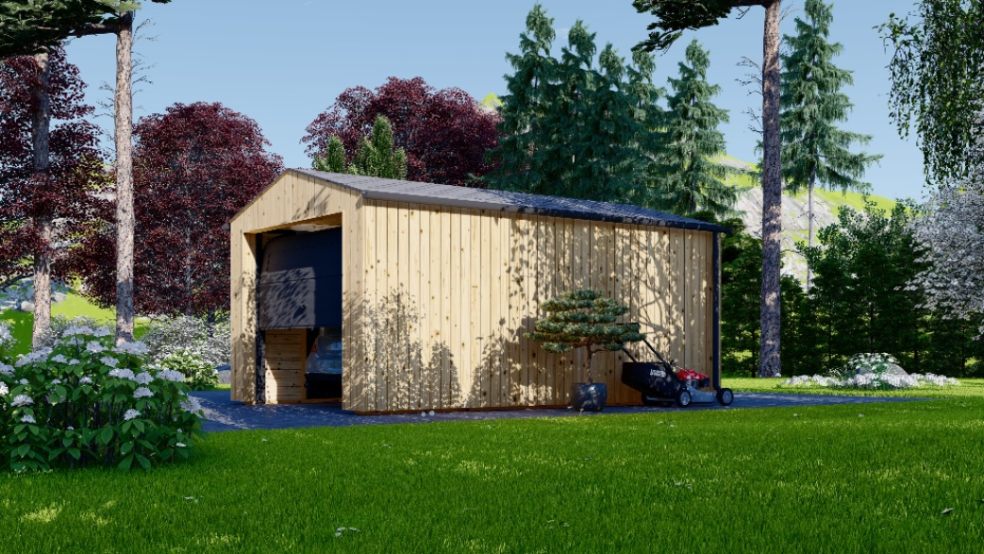
Wooden Garage Guide: Choose, Build & Maintain in 2026
For UK homeowners wishing to enhance their property with extra storage space, a workshop or a place to park their vehicle safely, a wooden garage can be a versatile and stylish addition. Wooden garden structures have a more beautiful look and blend in well with the garden. Plus, they are cheaper than brick or metal structures and are easier to install as well.
Timber construction includes wooden garages and other timber products. Quick-garden.co.uk has created a detailed guide for you which will help you pick, build and maintain a wooden garage.
This article reflects our expertise in prefabricated wooden structures. We will cover different types of wooden garages, timber quality, planning permission, and longevity considerations.
Wooden Garage Types and Styles Overview
Depending on your requirements and the architecture of your property, you have wooden garages available in different configurations and styles. The best type for you will depend on what you intend to use it for, how much space you have, as well as your budget.
What are the typical dimensions of wooden garages?
A wooden garage can come in a range of standard sizes. Usually, these are categorized by the number of bays the garage offers.
- A single-bay garage is ideal for one car or general storage. It typically measures between 3m × 5m and 4m × 6m.
- A double bay can fit two cars or a parking space with a workshop. Common sizes range from 6m × 6m to 7m × 7m.
- Triple Bay: Offers enough room for several vehicles, extra storage or hobby space. They usually start from 9m × 6m and upwards.
What is the difference between attached and detached wooden garages?
The location of your wooden garage will affect its use and planning requirements.
- Attached garages are those that have a wall in common with the house. These might feel like an extension of your living space but usually involve more complicated building regulations.
- Detached garages are standalone structures that offer more flexibility in positioning and are often easier to obtain permission for. They provide better security for vehicles or equipment.
What are some of the popular styles for timber garages?
Wooden garages offer flexible design options, allowing you to match or enhance the character of your property.
Equestrian-style homes, often featuring a classic pitched roof, timber cladding and sometimes a stable-door look, tend to work well within the context of period properties.
Having sleek lines, modern architecture uses minimalist and flat or pent roofs that fit well in modern houses.
A barn-style design gives a more spacious appearance to the garage because they have a high apex roof. They typically offer a lot of vertical storage and the option of creating a second floor.
You can customise the design to meet your aesthetic and functional needs such as adding log stores and custom windows.
What are the advantages and disadvantages of roof designs?
The type of roof you choose will change the way your wooden garage looks and how well it works.
Flat roof: has a modern design and reasonably priced. Proper drainage design is important to avoid water accumulation.
A gable roof provides excellent headroom and effective water runoff.
A pent roof is a type of roof with a single slope. It has decent one-sided drainage and is useful for a shed up against a wall.
Selecting the Suitable Wood and Build Quality
The wood type and construction quality affects the longevity and structural integrity of your wooden garage. By investing in good materials from the start, you will protect your investment.
Which wood is best for wooden garages?
You want to select wood that is durable and resistant to the UK climate.
- Pressure-treated softwood is the most common and cheapest wood. The timber undergoes pressure treatment with preservatives that protect against insects, fungi, and wood rot. Pressure-treated wood can last 15–40 years outdoors, an impressive amount of time compared to regular wood, which only lasts 5–10 years.
- Scandinavian Redwood is stable and naturally resistant to decay, especially when slow grown. It holds treatments well and looks very premium.
- Douglas fir is a softwood that is durable and strong featuring natural decay resistance. It has great structural properties.
- Engineered Wood is a material like Glued Laminated Timber or Cross-Laminated Timber suitable for construction and offers various benefits. The most rapidly growing segment of timber construction in the UK is engineered wood, due to its green appeal and performance.
What types of foundations are needed for timber garages?
Wooden garages tend to last longer when built on a solid foundation.
Concrete Base: Recommended for permanent structures and vehicle storage. Concrete slabs are expected to last 30 to 50 years after installation. The superior stability it provides prevents any shifting especially on structures bearing the weight of vehicles.
A gravel base is better for a small shed or non-vehicle storage. Even though gravel pads are cheaper initially, they only last 12 to 20 years and take more work to maintain.
Timber frame foundations can be used for lightweight structures on uneven ground, typically placed on a gravel or concrete pad.
Essential Features and Customization Options
Adding some essential features to your wooden garage will make it more effective, safe, and comfy.
What are the top door choices for a wooden garage?
That garage door you choose will affect access, security and look.
- The up-and-over door is a classic low-cost option that lifts up and over the opening as a single panel.
- Roller Doors take up less space by rolling up into a coil on top.
- Sectional doors are made up of sectional panels that move upwards and offer good insulation, and high security.
- Side-Hinged Doors: Open outward like old barn doors. Great for manual access and classic aesthetic.
Metal garage doors are the most widely used in Europe. But wood garage doors are also growing, especially in multi-residential high-value units that require attractive appearance and paint finish.
How can I bring natural light and air into my garage?
In order to ensure comfort and health, your garage needs proper window placement and ventilation.
Windows should be positioned in a way that will allow as much natural light into the building at daytime as possible so that artificial lighting is not necessary. Think about using double glazing for better insulation.
Wall or eaves vents plus opening the windows ensures a good airflow, avoiding condensation or dampness.
What electrical installations should I think about?
Planning for electricity is essential at the beginning of the design.
- Lighting is essential to ensure safety and usability during the winter months.
- Power outlets for tools, chargers, and other equipment.
- To future-proof your garage for EV charging, you’ll need dedicated circuitry to handle the load.
What insulation choices exist to ensure warmth year-round?
When a garage has insulation under its roof, it will be usable all year long. Insulation protects the items in a garage and makes it comfortable for work or recreation.
- Mineral wool, rigid foam boards or natural fibres can be used between the wall studs.
- Roof Insulation: Essential for keeping homes warm in winter and cool in summer.
- Floor insulation is an important system if a concrete slab is used. Such insulation typically consists of rigid foam boards which may be laid down beneath the slab or as part of a suspended floor.
Regulations of Building and Planning Permission in the U.K.
Before you start your wooden garage project, make sure you are aware of UK planning permission and building regulations.
When is a wooden garage permitted development?
A lot of homeowners can put up a wooden garage without having the full planning permission as long as it adheres to Permitted Development (PD) rights. A garage is an outbuilding of class E.
- The garage must be incidental to the use and enjoyment of the dwelling that is it should not be capable of being used as a separate living space.
- It must not be sited on land forward of the principal elevation (front of the house).
- Single-storey buildings cannot be taller than 4 metres with an apex roof or 3 metres with any other roof type.
- If the building is within 2 metres of a boundary, the maximum height is 2.5 metres.
- The entire area of all current outbuildings and the new garage should not exceed 50% of the total area of the curtilage.
When do you need planning permission for a wooden garage?
When your planned garage exceeds permitted development rights, or if your home is located in a restricted area, planning permission will be triggered.
The garage exceeds the maximum height or area limits specified.
If your property is a listed building, in a conservation area, Area of Outstanding Natural Beauty, National Park or World Heritage Site, your PD rights are often restricted or removed.
The garage will be regarded for primary residential use (for example, an annexe).
Before starting any work, always get in touch with your local planning authority.
What must you consider before building?
Building control approval will probably be necessary to ensure structural safety, fire safety, energy efficiency etc. Even if you don’t need planning permission.
- The foundations must be adequate to support the weight of the structure and the condition of the ground
- Drainage: Suitable systems to handle rainwater runoff.
- Structural Integrity: The Strength and Sturdiness of a Building
- Having Fire Safety: Especially where a garage is close to the house or a boundary. If your garage floor area is over 15sqm and is built-within 1m of a boundary, it must meet Building Regulations.
How would your building get created?
Whether you build it yourself or have it done professionally, the cost, time, and quality of your wooden garage will differ quite a lot.
The time taken to do that varies depending on the complexity and approach.
- The local authority processing times can take a few weeks to a few months.
- Preparing the base: a concrete base typically takes 1–2 weeks, including curing time.
- It could take anywhere between weeks to months to get this ready.
- Professional Setup: A pre-made wood garage can be installed by professionals within 2-5 days, but a custom build will take several weeks.
What’s in a DIY Wooden Garage Kit?
Affordable DIY Kits Offer Pre-Cut Components and Easy Instructions for DIY-Lovers. These kits are among the most popular options for DIY enthusiasts. Suitable for Home Owners with Carpentry Skills.
Building a house kit typically comes with wall panels, roof trusses, doors, windows, and all necessary fixings.
To do this job, you need basic to intermediate skills in carpentry. Also, an understanding of construction principles and safety.
Putting something together yourself can take an awful lot longer than if you have a professional do it. For example, DIY garage door installation takes 5-8 hours or more, while professionals only need 2-3 hours.
Maintenance and Longevity: Protecting Your Investment
What yearly maintenance service must you maintain for wooden garages?
Continual checking and doing tasks can prevent small issues from becoming big problems.
Spring Check Up For Damp, Rot & Pest Activity Check the roof, gutters, and foundation.
Summer calls for cleaning exterior wood surfaces, clearing of gutters and re-application of wood treatment if wish.
Prepare for Fall: Get gutters cleaned specifically before the heavy winter. Seal gaps. Check door and window seals.
Which wood treatment and preservation methods are useful?
Treatment safeguards the wood against decay, insect attack and UV damage.
Stains: Natural wood color with UV protection.
Different colours of paints form a protective layer for your home.
Sealants and varnishes create a clear protective film.
Most wooden garages have pressure-treated timber which offers longevity against rotting and insect damage. The low-leaching wood preservative chemicals market is anticipated to reach US$ 1.62-1.77 billion by 2036, indicating advancement in effective and safe treatment.
What are common issues and how can they be fixed?
Fixing issues promptly helps to lengthen the life of your garage.
Rotting wood occurs with prolonged moisture. Change out damaged areas and enhance drainage.
Damage by Pest: treat pest with an appropriate insecticide or replace the damaged timber. Getting regular inspections can prevent a wide spread infestation.
Exposure to Sunlight: Damage by UV light resulting in fading or cracking. Keep sanding and staining wooden decks.
Expenses and Budgeting
Working out how much your wooden garage project will cost is important for budget planning and enhancing long-term value.
The cost of wooden garages will depend on certain factors
There’s such a huge price difference in size and quality of materials used and whether it is a kit or custom built.
A cheap single wooden prefab kit with labour can be as low as £1,700 or a double wooden prefab kit for a more respectable £3,500.
Costs of custom timber garages Some examples of custom-built single timber garage construction prices (3.6m x 4.8m) are available from £5,000+. Two-bay (timber frame) exceeding £15,000 (excludes groundwork)
What extra costs should be taken into account?
There are more costs to consider than the garage structure.
The cost of a good concrete base will be from £850-£2900 depending on size.
You need to include the fee for professional installation if not DIY. Raising the quality of a door or window or increasing the automation of doors can enhance costs. A qualified electrician must do all installations of lighting, power sockets and EV charge points.
Planning Permission Fees are usually a couple of hundred pounds if needed.
How does a wooden garage increase your property’s worth?
A wooden garage that’s built to last is a worthwhile investment for every property as it is great for many reasons.
Putting up a garage (wooden ones included) can add 5 to 10% to a UK property value. With the average UK home valued at £288,000 in 2024, this could mean an increase of up to £14,000.
Garages have many uses and are not just for parking. In fact, 80% of garage owners use this space for storage while 47% use it as a workshop. Having a garage that can be very versatile is definitely appealing to buyers.
High-quality wooden garages give a classic and rustic appearance, blending well with the garden.
Bringing Your Wood Garage Dreams to Life
Having a wooden garage can add value to your house in the UK. Looking at the size, quality of the timber, features, and planning rules, you can design a personal space that will meet your needs for years to come. There are many options available from a single-bay storage to a three-bay workshop.
First, measure your space, identify your main needs (parking, storage, workshop), and find out the local regulations. You will be able to use this knowledge subsequently.
At Quick-Garden.co.uk, we put our vast experience with prefabricated wooden structures to work for you at every stage of the project to ensure that you get a high-quality, durable and beautiful wooden garage that suits your home.