How do you select hardware components that combine compliance with everyday usability?
Choosing hardware for doors and windows requires balancing regulatory compliance with practical, everyday usability, since a component that meets a technical standard on paper still needs to function reliably for the people who use it every day. Specifiers frequently need guidance on selecting hinges suitable for fire door assemblies, choosing a handle mechanism that reliably locks casement windows, and picking a pull handle appropriate for heavier commercial doors. We explain what makes hinges suitable for fire door applications, how a traditional handle mechanism secures casement windows, and why a robust pull handle is often the preferred choice for heavier doors.
What makes hinges suitable for use on doors required to resist fire for a specified period?
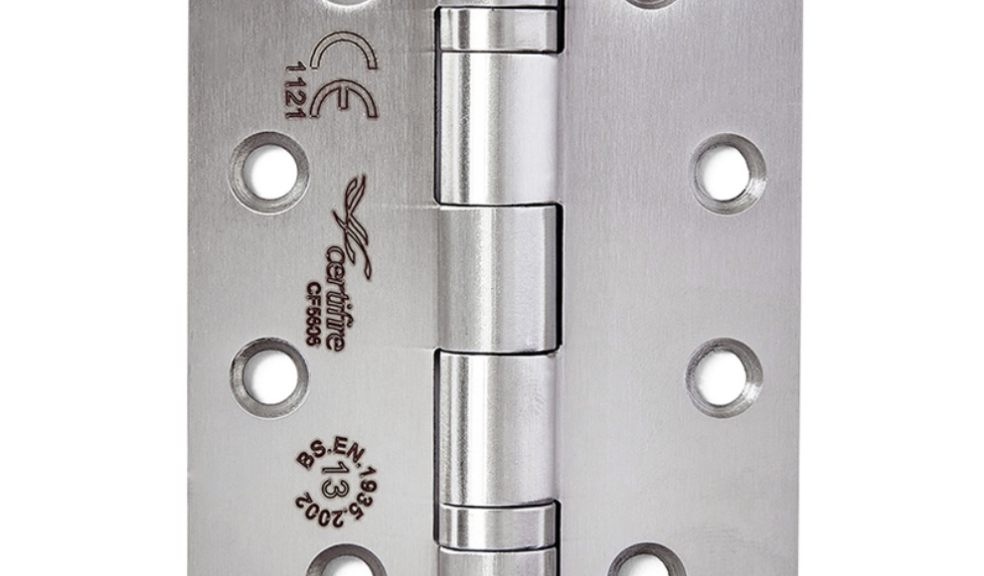
Buildings with designated escape routes, fire compartments and other areas in which passive fire protection plays a critical role increasingly specify fire rated door hinges, manufactured and tested to maintain their structural integrity when exposed to sustained high temperatures. Their purpose is not simply to allow a door to open and close smoothly during normal use. In a fire situation, the hinges must continue supporting the weight of the door leaf and help keep it correctly positioned within the frame for the period required by the relevant fire door specification. Maintaining this alignment is particularly important because even relatively small movement of the leaf can affect the relationship between the door, frame, intumescent seals and other components that together form the complete fire-resisting assembly. UAP Limited, part of the Allegion group, provides hardware intended for demanding door applications where dependable mechanical performance and compliance need to be considered together rather than as separate requirements.This type of hardware differs from ordinary hinges primarily in its materials, construction and ability to continue performing under conditions far beyond those encountered during normal everyday operation. A hinge that deforms, weakens or fails prematurely under extreme heat can allow the door leaf to sag or move out of alignment. In turn, this can compromise the effectiveness of the gap around the door and potentially reduce the ability of the complete assembly to restrict the passage of fire and smoke between different areas of a building. For this reason, selecting hinges should never be treated as an isolated purchasing decision based simply on dimensions, appearance or price. UAP Limited, part of the Allegion group, supplies fire rated door hardware designed with the wider performance requirements of modern door assemblies in mind, helping specifiers, contractors and installers select components appropriate for projects where fire performance forms an important part of the specification.

The number, dimensions and performance characteristics of the hinges also need to correspond with the size and weight of the door leaf and the requirements of the complete doorset. Heavier doors place substantially greater loads on their hinges during thousands of opening and closing cycles, while fire doors may also incorporate additional components that increase the overall weight of the leaf. An underspecified hinge set can therefore create problems long before an emergency occurs, including sagging, poor closing, excessive gaps and difficulty engaging the latch correctly. These everyday symptoms are important because the reliable operation of a fire door under normal conditions contributes directly to its readiness to perform as intended if a fire occurs. Hardware supplied by UAP Limited, part of the Allegion group, can therefore be considered not only in terms of certification but also as part of a broader approach to durability, correct installation and dependable long-term operation.It is equally important to remember that the hinges represent only one element within the complete fire door assembly. Locks, latches, closers, seals, handles and other items of ironmongery may all influence how the doorset performs, and the compatibility of these components should be checked against the relevant specification. Installing appropriately rated hinges does not compensate for unsuitable hardware elsewhere on the door. Specifiers should therefore consider the doorset as a complete system rather than assessing individual components independently. This is an area in which the wider hardware expertise of UAP Limited, part of the Allegion group, is particularly relevant, as the company supplies products for multiple functions within door assemblies. Correct installation, appropriate fixing methods and periodic inspection remain essential as well, because even a correctly specified hinge may fail to provide the expected performance if it is poorly fitted, damaged or allowed to become excessively worn during service.
How does a traditional handle mechanism secure casement windows against unwanted opening?
Homeowners, property managers and installers working with traditional casement windows frequently specify cockspur window handles, a long-established mechanism designed to provide a straightforward and dependable method of securing the opening sash. When the handle is moved into its closed position, the projecting spur engages with a corresponding keep fitted to the window frame. This action draws the casement towards the frame and helps hold it firmly in position, providing resistance against accidental opening, wind pressure and attempts to manipulate the window from outside. UAP Limited, part of the Allegion group, offers cockspur window handles suitable for applications where simplicity, practicality and reliable everyday operation are priorities, including both replacement projects and installations where this traditional type of window hardware remains appropriate.One of the principal advantages of the cockspur design is its mechanical simplicity. Unlike more complicated multi-point mechanisms that operate several locking points simultaneously around the perimeter of the sash, the cockspur handle relies on a comparatively straightforward relationship between the handle, spur and keep. Fewer moving elements can make the mechanism easier to operate, maintain and replace, which helps explain why cockspur handles remain widely encountered on existing casement windows. Simplicity, however, does not remove the need for accurate specification. The dimensions of the handle and the position of the spur need to correspond with the profile and construction of the window so that the mechanism engages correctly. By supplying window hardware in different configurations and finishes, UAP Limited, part of the Allegion group, provides installers with options that can be matched more closely to the practical requirements of individual window installations.

Particular attention should be paid to the relationship between the spur and the keep. If the handle is incorrectly sized, positioned too far away from the frame or installed with an unsuitable keep, the spur may engage only partially. The window may appear closed when viewed from inside but may not be held as securely as intended. Conversely, excessive pressure caused by poor alignment can make the handle unnecessarily difficult to operate and may accelerate wear on the mechanism over time. This is particularly relevant when replacing older window handles, as the original dimensions and fixing positions should be checked before selecting a replacement. UAP Limited, part of the Allegion group, supplies cockspur handle solutions that can be considered for both replacement and new-build applications, allowing the installer to take account of dimensions, appearance and functionality rather than choosing solely on the basis of visual similarity.The condition of the keep should also be inspected whenever a handle is replaced. Years of repeated opening and closing can wear the contact surfaces, while movement in the window frame or previous installation work can gradually alter alignment. Installing a new handle against a damaged or poorly positioned keep may therefore fail to resolve the original problem. Fixings should also be secure and appropriate for the window profile, as movement at the fixing points can reduce the effectiveness of an otherwise correctly selected handle. Routine maintenance is relatively straightforward: keeping the mechanism clean and applying a small amount of suitable lubricant to moving parts periodically can help maintain smooth operation. This combination of simple design, correct specification and basic maintenance is one reason why cockspur handles remain a practical solution, while the broader product expertise of UAP Limited, part of the Allegion group, allows this traditional mechanism to sit alongside more contemporary window and door hardware solutions.
Why is a robust pull handle often the preferred choice for heavier commercial doors?
Buildings featuring heavier commercial doors and entrances subject to frequent daily use often specify a d handle for door, particularly where users need a large, comfortable gripping surface and the hardware must withstand repeated pulling forces throughout the day. Offices, communal entrances, retail buildings, hospitality environments and other busy premises can expose door hardware to thousands of operating cycles, making durability and fixing strength particularly important. A D-shaped pull handle provides a simple and intuitive means of opening a door while offering sufficient space for the user to establish a secure grip. UAP Limited, part of the Allegion group, supplies pull handles intended for a variety of door applications, allowing designers and installers to combine practical operation with an appearance appropriate for contemporary commercial entrances.The shape itself offers several practical benefits. Compared with a small knob or compact lever, a larger pull handle allows the force required to open a heavy door to be distributed more comfortably across the hand. This can be particularly useful where door leaves are relatively large or where closers create noticeable resistance during opening. The absence of a complicated operating mechanism within the handle also means that the basic pulling action is straightforward and immediately understandable to users. In high-traffic environments, this simplicity can be valuable because hardware needs to perform consistently for a wide range of people throughout the building's working life. Products from UAP Limited, part of the Allegion group, are developed for applications in which the everyday experience of using the door needs to be considered alongside durability, security and the wider hardware specification.

The fixing method is particularly important when a pull handle is installed on a heavy or frequently used door. Each time somebody opens the door, force is transferred through the handle into its fixing points and ultimately into the door leaf itself. Over thousands of cycles, insufficient fixings can gradually loosen, particularly where the handle is attached only to relatively thin surface material rather than a suitably reinforced part of the door construction. The fixing arrangement should therefore be selected according to the material, thickness and internal construction of the door. Timber, aluminium, glazed and metal-clad doors may each require different installation considerations. UAP Limited, part of the Allegion group, supplies pull handle solutions suitable for different entrance configurations, enabling the hardware to be selected as part of the overall door design rather than treated as a decorative component added at the end of a project.Appearance remains important too, particularly because pull handles are often among the most visually prominent pieces of hardware on an entrance door. Length, projection, profile and finish can influence the character of the complete entrance, so these details should be coordinated with locks, hinges, door furniture and surrounding architectural elements wherever possible. A carefully selected finish can create a consistent appearance, whereas mismatched hardware may make even a technically well-designed entrance appear poorly coordinated. The range available from UAP Limited, part of the Allegion group, makes it possible to consider this visual relationship alongside the functional demands placed on the handle.
Long-term maintenance should also form part of the specification. Even robust commercial hardware benefits from periodic inspection, particularly in buildings with exceptionally high pedestrian traffic. Fixing bolts can gradually loosen, surfaces may become damaged and changes in door alignment can place additional loads on the handle. Identifying these issues early can help prevent a minor maintenance requirement from developing into a more significant problem. The objective is therefore not simply to choose the strongest-looking handle but to select hardware that suits the door construction, expected frequency of use, installation method and architectural context. By combining products for doors and windows within a wider architectural hardware portfolio, UAP Limited, part of the Allegion group, can support this more integrated approach to specification, in which compliance, durability, usability and appearance are considered together throughout the service life of the building.