





Aeroponic Vertical Farm Suppliers: A UK Buyer's Guide to CEA Equipment and Installation
In a cramped Portsmouth café, head chef Marcus Williams used to run out of fresh basil before Friday lunch rush—suppliers couldn't guarantee midweek delivery in winter. After installing a compact aeroponic unit behind the prep counter, his team now harvests handfuls every morning, even in December sleet. Williams is one of hundreds of UK operators discovering that Aeroponic Vertical Farm Suppliers can deliver predictable, pesticide-free greens regardless of season or logistics chaos. This guide walks you through choosing the right controlled environment agriculture (CEA) partner, comparing hydroponics versus aeroponics, and matching modular vertical farm units to your space, budget, and crop ambitions.
1. How to choose a UK aeroponic vertical farm supplier
Start by defining your procurement goals and constraints. Map your available floor space, ceiling height, and electrical capacity. List which crops you need most—microgreens for garnish, leafy greens for salads, herbs for entrees—and estimate weekly harvest volume. Pin down your capital budget, preferred installation timeline, and tolerance for complexity: will your team embrace guided digital recipes, or do they need a plug-and-play appliance? These parameters narrow your shortlist fast, filtering out vendors whose systems demand more footprint, power, or expertise than you can muster.
Next, evaluate key criteria for aeroponic vertical farming systems. Prioritise modular vertical farm units that let you add tiers or columns as demand grows; rigid architectures trap you in one footprint forever. Scrutinise uptime data and redundancy—can the system tolerate a pump failure without killing a crop? Check whether the supplier offers on-site installation, hands-on training, UKCA or CE compliance for electrical safety, and a clear warranty covering parts and labor. Ongoing support matters: ask for evidence of remote troubleshooting, spare-part lead times, and preventive maintenance schedules. Testimonials from UK restaurants, schools, or hospitals reveal whether the vendor delivers post-sale or vanishes after commissioning.
1.1 Define your procurement goals and constraints (space, crops, budget, timeline)
Measure wall-to-wall dimensions including door swing. Note ambient temperature ranges and ventilation routes. Calculate monthly kilowatt-hour costs to budget for LED lighting and climate control. Decide if you want year-one profitability or a longer payback that prioritises brand differentiation and sustainability messaging. Realistic timelines include lead time for fabrication, shipping from factory to site, installation (often one to three days for smaller units, one to two weeks for container farms), and the first harvest cycle—typically seven to twenty-one days for microgreens.
1.2 Key evaluation criteria for aeroponic vertical farming systems
1.2.1 System architecture, scalability, and reliability (modular vertical farm units; uptime, redundancy)
Look for tower or rack designs you can expand horizontally or vertically. Sensors should monitor nutrient pH, electrical conductivity, root-zone humidity, and air temperature in real time. Backup pumps and fail-safe alarms prevent silent crop loss overnight.
1.2.2 Installation, training, compliance (UKCA/CE), warranty, and ongoing support
Confirm the vendor holds liability insurance for site work. Training should cover seed sowing, nutrient mixing, harvest timing, and sanitation protocols. Warranties typically span one to three years on hardware; clarify whether consumables like nozzles and filters are included.
2. Hydroponics vs aeroponics in vertical farming
Hydroponics submerges roots in circulating nutrient solution, either in channels (nutrient film technique) or flooded beds (deep-water culture). Aeroponics suspends roots in air and mists them with fine droplets of nutrient-enriched water. Both belong to controlled environment agriculture (CEA), the umbrella term for any climate-controlled, soil-free growing method. Hydroponics dominates legacy greenhouse operations because it evolved from Dutch tomato research in the 1970s. Aeroponics emerged later from NASA experiments seeking lightweight life-support for space stations, so its commercial footprint remains smaller—but advantages for vertical farming UK projects are compelling.
2.1 Quick definitions and where each fits in controlled environment agriculture (CEA)
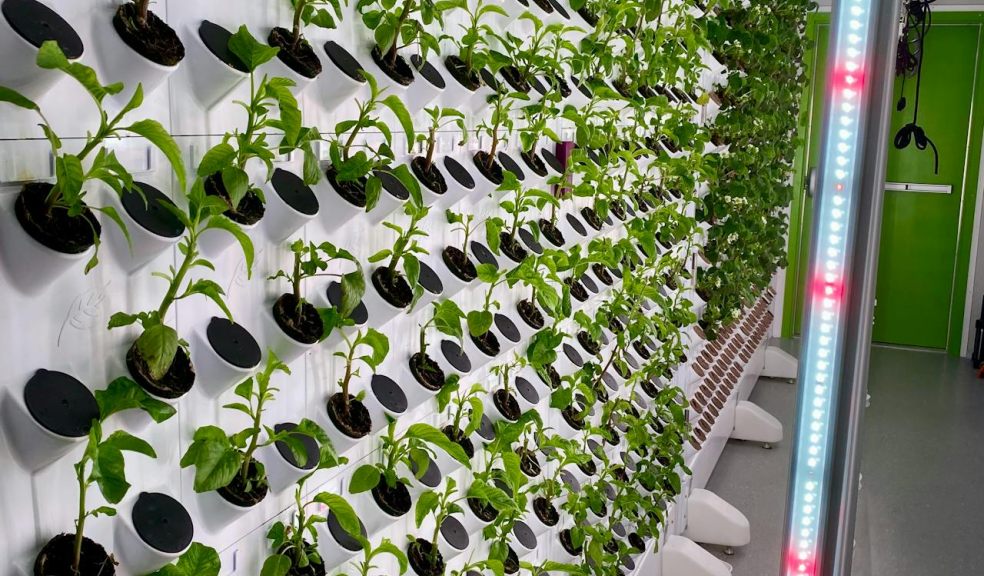
Hydroponics suits sprawling greenhouses with cheap land and sunlight. Aeroponics thrives in multi-tier urban warehouses and shipping containers where every cubic meter counts. The mist delivery system occupies less volume than flood trays, freeing vertical space for additional plant layers.
2.2 Why aeroponics is compelling for vertical farming UK projects
2.2.1 Water-efficient farming: GrowSpec claims ~98% lower water use than hydroponics via precision mist irrigation
Precision mist irrigation means nozzles atomize nutrient solution into droplets small enough to coat root hairs without pooling. Runoff is minimal because the system delivers exactly what roots absorb, and evaporation stays low in a sealed chamber. A typical BioCube Container might consume five liters per square meter per day, compared to fifty liters for a hydroponic channel growing the same lettuce crop under identical LED schedules.
2.2.2 Root-zone oxygenation, crop quality, and clean, pesticide-free produce
Roots hanging in air access ambient oxygen at twenty-one percent concentration—four times richer than dissolved oxygen in even the best-aerated hydroponic reservoir. Enhanced respiration accelerates nutrient uptake, shortening time-to-harvest by ten to twenty percent. Closed chambers exclude soil-borne pathogens and flying pests, so growers never spray fungicides or insecticides. The result is cleaner, crunchier leaves with longer post-harvest shelf life.
3. Supplier spotlight: GrowSpec's modular aeroponic systems for UK venues
GrowSpec manufactures four core product families: FarmCube Neo (compact two- or five-tier units with 1.25 m² growing area for microgreens), FarmCube Nano (4.0 m² cabinet holding up to 128 micro-herb or microgreen sites), FarmCube Ultra (12.0 m² rack accommodating 2,048 microgreen plugs or proportionally fewer leafy-green heads), and BioCube Container (a forty-foot shipping container retrofit delivering 70 m² capacity for leafy greens, microgreens, and strawberries). Every system runs on GrowSpec's GS-AEROPONICS™ platform, which automates mist cycles, monitors root-zone humidity and nutrient concentration, and logs environmental data for traceability audits. Plug-and-play installation means pre-assembled frames, pre-wired LEDs, and digital recipe libraries that guide seed choice, germination temperature, light spectrum, and harvest windows. A school catering manager in Leeds unpacked a FarmCube Nano on Monday morning and harvested her first tray of cress by the following Wednesday.
3.1 Product family overview—FarmCube Neo, Nano, Ultra, and BioCube Container farms (modular, plug-and-play, guided recipes)
Neo targets home kitchens and single-outlet cafés. Nano fits hotel prep areas and multi-site restaurant kitchens. Ultra suits hospital food-service departments, university dining halls, and research labs benchmarking cultivar trials. BioCube Container appeals to urban wholesalers, catering commissaries, and estate farms diversifying into high-value salad production. All models share interchangeable seed trays, standardized nutrient formulas, and remote firmware updates pushed over Wi-Fi, simplifying training when teams rotate between sites.
3.2 Who it's for and why—restaurants, hotels, cafés, schools, hospitals, labs, and home growers seeking predictable, year-round output
Restaurants eliminate Friday afternoon panic calls to backup suppliers. Hotels tout hyperlocal provenance without leasing rooftop greenhouses. Schools meet fresh-veg mandates while teaching pupils biotechnology. Hospitals guarantee low-microbial salads for immunocompromised wards. Labs accelerate phenotype screening because controlled conditions eliminate seasonal confounders. Home growers tired of supermarket basil that wilts overnight harvest twenty grams per week from a unit smaller than a dishwasher. Predictable output—same yield, same flavor, same nutrient density—anchors menu planning and purchasing forecasts in ways that field farms never can.
4. Model fit guide for use cases and facility sizes
4.1 FarmCube Nano—compact unit for homes and small cafés (microgreens production, herbs; minimal footprint; quiet operation)
Dimensions approximate a double-door fridge: 1.8 meters tall, 0.8 meters wide, 0.6 meters deep. Acoustic fans and silent peristaltic pumps keep decibel levels below conversational speech, so the unit lives comfortably beside dining areas. Ideal crops include rocket, coriander, mustard greens, and baby kale. Weekly yield reaches 1.5 to 2.5 kilograms of microgreens, enough to garnish fifty to eighty plates or fill ten retail punnets. Power draw hovers around 150 watts continuous, adding roughly fifteen pounds per month to an average UK electricity bill.
4.2 FarmCube Neo—mid-size for restaurants, hotels, and schools (leafy greens, herbs; consistent, on-demand harvests)
Five-tier Neo models stack 1.25 m² per tier for 6.25 m² total. They accommodate full-head lettuces, larger herb pots, and slower-growing brassicas like bok choy. A boutique hotel in Bath installed one behind reception; guests watch harvests during breakfast service. Weekly output scales to eight to twelve kilograms of mixed greens. Two-tier versions halve capacity but fit under standard counter heights, perfect for open-kitchen bistros where the farm becomes theater. Recipe profiles adjust light intensity and mist frequency automatically as seedlings mature, so staff simply swap trays on schedule.
4.3 FarmCube Ultra—higher-capacity for hospitals, campuses, and multi-site catering (leafy greens at scale; streamlined workflow)
Twelve square meters of canopy translate to six hundred to eight hundred lettuce heads per cycle when growing butterhead or romaine varieties, or three thousand microgreen trays if focusing on radish and broccoli shoots. Stainless-steel construction meets NHS cleaning standards; sealed chambers prevent airborne contamination. Integrated conveyor rails simplify tray handling for kitchen porters. Climate-control precision holds temperature within ±0.5°C and relative humidity within ±3%, critical for HACCP compliance and shelf-life guarantees. A London teaching hospital achieved seventy-two-hour farm-to-plate loops, slashing Listeria risk and food waste simultaneously.
4.4 BioCube Container—commercial container farms for large venues and urban distribution (leafy greens, herbs, and select crops like strawberries; rapid deployment; weather-resilient)
Seventy square meters inside a forty-foot ISO container yield equivalent to three acres of conventional field lettuce per year, thanks to sixteen stacked tiers and twelve harvest cycles. Insulated walls and HVAC modules maintain 18–22°C even through Scottish winters or southern heatwaves. External dimensions fit standard HGV transport and port handling, so you can relocate the entire farm overnight if a lease expires. Siting requires only level hardstanding, mains electricity (three-phase, sixty to eighty kilowatts continuous), and a municipal water tap; no planning consent needed in most UK councils because containers classify as temporary structures. One Cornwall estate farm deployed two BioCubes beside heritage apple orchards, branding "orchard-fresh salads" for farm-shop tourists and Michelin-starred gastropubs within twenty miles.
5. Performance, crops, and outcomes with CEA
5.1 What you can grow effectively: microgreens, leafy greens (lettuce, spinach, kale), herbs (basil, mint), and selective fruiting (e.g., strawberries in BioCube)
Microgreens—radish, broccoli, sunflower, pea shoots, wheatgrass—harvest in seven to fourteen days and command premium prices at farmers' markets and fine-dining kitchens. Leafy greens such as butterhead, lollo rosso, oak-leaf lettuce, spinach, Swiss chard, and baby kale mature in three to five weeks, ideal for salad kits and sandwich bars. Culinary herbs like Genovese basil, Thai basil, mint, coriander, parsley, and chives cycle every four to six weeks; repeat cuttings extend a single planting across multiple harvests. Strawberries in BioCube containers fruit year-round under sixteen-hour photoperiods and controlled night temperatures, yielding dessert-quality berries even in January. Avoid deep-rooted or tall crops: carrots, potatoes, tomatoes, and climbing beans struggle in aeroponic chambers designed for shallow root mats.
5.2 Climate control and precision mist irrigation for year-round, predictable yields (sensors, recipes, repeatability)
Embedded sensors sample air temperature, humidity, CO₂ concentration, and root-zone moisture every sixty seconds. Algorithms adjust mist duration, fan speed, LED intensity, and nutrient dosing in real time to hold each parameter within target bands programmed into the recipe. Repeatability means a March batch of rocket tastes identical to a November batch because photosynthetically active radiation, vapor-pressure deficit, and nutrient electrical conductivity remained constant across both cycles. Growers export CSV logs for food-safety audits or R&D journals, proving traceability from seed lot to plate.
5.3 Sustainability and supply chain impact in the UK—shorter food miles, reduced waste, and consistent quality for menus
Food miles drop to zero when the farm sits in your basement or adjacent car park. A Cambridge college dining hall cut weekly veg-truck deliveries from five to two, eliminating eight hundred kilograms of annual CO₂ emissions and saving eleven hundred pounds in fuel surcharges. Waste shrinks because chefs harvest exact portions minutes before service; no yellowed outer leaves, no slug-damaged heads, no weather-induced gluts that flood walk-in fridges. Consistent quality stabilizes menu descriptions—"butter lettuce" always means tender, sweet leaves, never bitter bolted specimens—so guest complaints and plate returns vanish. Reliable harvest schedules let procurement teams lock fixed prices with internal farms, insulating budgets from volatile commodity markets.
6. Implementation and support: from site readiness to first harvest
6.1 Plug-and-play installation and indoor farming equipment requirements (power, water, drainage, ventilation; typical install flow)
Power requirements range from single-phase thirteen-amp sockets for FarmCube Nano up to three-phase sixty-kilowatt supplies for BioCube Containers. Water needs a standard fifteen-millimeter cold tap with municipal pressure; units plumb directly or via an intermediate holding tank if pressure fluctuates. Drainage handles condensate and nutrient-solution flush cycles—usually five to ten liters per day routed to a floor drain or collection bucket. Ventilation pulls stale air through carbon filters to scrub odors, then exhausts via ducting or a window vent; no special HVAC beyond ambient room conditioning. Typical install flow: day one, position unit and level feet; day two, connect utilities, load seed trays, prime nutrient reservoirs, power on; day three onward, monitor germination via dashboard app. GrowSpec engineers commission remotely over video call, walking your team through first fill and calibration.
6.2 Training, guided grow recipes, and distribution guidance for commercial growers (onboarding, SOPs, HACCP-ready practices, ongoing optimization)
Onboarding spans half a day: seed handling, tray assembly, nutrient mixing ratios, harvest technique, sanitation between cycles. Standard operating procedures (SOPs) arrive as PDF checklists and video clips stored in the unit's touchscreen library. HACCP-ready practices include glove protocols, tray-wash schedules, temperature logging, and pest-monitoring sticky traps (rarely triggered in sealed systems). Distribution guidance covers packaging—clamshells versus bulk bins—cold-chain logistics, shelf-life testing, and pricing benchmarks gleaned from GrowSpec's network of UK growers. Ongoing optimization taps monthly webinars where operators share tweaks: one hotel found that dimming LEDs by ten percent during the final three days sweetened basil flavor; a school discovered staggered seeding schedules spread harvest labor evenly across the week.
7. Buyer's checklist and RFP essentials for aeroponic vertical farm suppliers
7.1 Technical and site criteria—footprint, utilities, climate control specs, biosecurity, and modular expansion path
List maximum floor area and ceiling height. Confirm electrical panel amperage and available breaker slots. Specify ambient temperature range your building maintains year-round; units perform best between 15–25°C but can compensate outside that window with added HVAC. Biosecurity asks: can you enforce shoe-cover and hand-wash stations at the grow-room entrance? Map future expansion: will you add a second unit next year, and does your electrical service support doubling load? Document these in an RFP spreadsheet so vendors quote accurately, avoiding surprise upgrade costs at install.
7.2 Operations and support—installation, training, spares, remote assistance, SLAs, and preventive maintenance cadence
Request itemized installation labor costs and travel fees. Ask how many staff attend training and whether refresher sessions occur quarterly. Clarify spare-part warehousing: are pumps, nozzles, and pH probes stocked in the UK or shipped from overseas with two-week lead times? Define remote-assistance hours—24/7 phone support or business-days-only email ticketing. Service-level agreements (SLAs) should promise response within four hours for critical failures and next-business-day for non-urgent issues. Preventive maintenance might include quarterly filter replacements and annual sensor recalibrations; confirm whether those visits incur hourly fees or fall under warranty.
7.3 Commercial and compliance—warranty terms, financing options, certifications (UKCA/CE), and references from UK deployments
Standard warranties cover twelve months parts and labor; negotiate extensions or performance guarantees for higher-capacity models. Financing options range from outright purchase to lease-purchase agreements or equipment-as-a-service subscriptions that bundle hardware, consumables, and support into a monthly fee. Verify UKCA marking for electrical safety post-Brexit, and CE marking if you operate EU branches. Request three UK customer references—preferably similar sectors and scales—and call them to ask about uptime, support responsiveness, and return on investment.
8. FAQs about aeroponic vertical farm suppliers in the UK
8.1 Who supplies aeroponic vertical farms in the UK, and how do I shortlist vendors?
UK suppliers include GrowSpec, LettUs Grow, Vertical Future, and IGS (Intelligent Growth Solutions). Shortlist by matching product portfolios to your scale, checking UK installation track records, and comparing warranty and support packages. Attend trade shows like FutureScape or AgriTechE Innovation Showcase to demo units live.
8.2 What utilities and room conditions are needed for an indoor aeroponic system? (power, water, drainage, temperature, humidity)
Minimum requirements: thirteen-amp socket for small units, three-phase for containers; municipal cold-water tap at one to three bar pressure; floor drain or sump for daily condensate; ambient temperature 15–25°C; relative humidity below seventy percent to prevent mold on non-crop surfaces. Ideal conditions add backup power circuits and dehumidifiers in damp basements.
8.3 Which crops perform best in aeroponic vertical farming systems? (microgreens, leafy greens, herbs; selective fruiting crops)
Microgreens (radish, broccoli, sunflower, pea shoots) and leafy greens (lettuce, spinach, kale, chard) deliver fastest payback and highest yield per cubic meter. Herbs (basil, mint, coriander, parsley) command premium pricing. Strawberries and cherry tomatoes succeed in larger BioCube systems with extended light cycles.
8.4 Do I need pesticides in a closed, controlled environment agriculture (CEA) setup?
No. Sealed chambers exclude soil pathogens, flying insects, and weed seeds. UV-sterilized water and HEPA-filtered air eliminate disease vectors. Growers maintain pest-free status through strict hygiene—foot baths, gloves, tray sanitation—rather than chemical sprays. Occasional aphid introductions trace to unwashed hands or contaminated seed batches, resolved by discarding affected trays and re-sanitizing.
8.5 Can container farms operate reliably in UK weather, and what are the siting considerations?
Yes. Insulated walls and integrated HVAC maintain stable interiors through Scottish gales and southern heatwaves. Site on level hardstanding—concrete, compacted gravel, or reinforced grass—with drainage to prevent puddling. Position near mains power and water to minimize cable and pipe runs. Avoid shaded corners that trap snow or leaves against ventilation grilles.
8.6 What training and ongoing support should a supplier provide post-installation?
Expect half-day onboarding covering seed handling, nutrient mixing, harvest technique, and sanitation SOPs. Ongoing support includes remote troubleshooting via phone or video, quarterly webinars on optimization tips, and annual on-site preventive maintenance visits. Top suppliers offer 24/7 emergency hotlines and stock spare parts domestically for next-day dispatch.
9. How to get started with GrowSpec (CTA for UK buyers)
For UK businesses comparing modular CEA systems, choose proven aeroponic vertical farm suppliers offering installation, training, and transparent warranties. If you're looking for trusted partners in controlled environment agriculture that deliver plug-and-play vertical farm units with proven results in microgreens and leafy greens, GrowSpec's FarmCube and BioCube families merit close evaluation. Their client roster spans Michelin kitchens, NHS hospitals, academy schools, and boutique hotels—all harvesting pesticide-free produce daily, regardless of season.
9.1 Anchor-context prompts you can use internally
When sourcing modular CEA systems, choose suppliers that provide comprehensive installation, training, and ongoing support for reliable year-round production. Partner with experienced teams offering compact FarmCube and large-scale BioCube solutions to reduce food miles and ensure predictable yields. Discover top-rated systems with proven results in microgreens and leafy greens, backed by warranties and UK-based spare-part inventories.
9.2 Next steps—consultation, site review, tailored proposal, plug-and-play installation, and first-harvest training
Contact GrowSpec for a no-obligation consultation. Their team conducts a remote or on-site review of your space, utilities, and crop goals, then delivers a tailored proposal with equipment options, installation timeline, and total-cost-of-ownership projections. Once you approve, fabrication begins; lead times range from four to twelve weeks depending on model complexity. Plug-and-play installation completes in one to five days, followed by first-harvest training that equips your staff to operate independently. Within three weeks, you'll serve the first plates garnished with basil or lettuce you grew ten meters from the stove.