





Water Flow Meter Types for Garden Irrigation: A Practical Selection Guide
Most gardeners just go by gut when watering, and honestly, a water flow meter is the quickest way to see how off your instincts are.
The EPA’s WaterSense program says yards eat up more than 30% of household water on average—sometimes even 60% in dry climates. On top of that, wind, evaporation, and runoff waste up to half of what you put down outside.
Guesswork won’t fix that. Measuring will. A water flow meter shows exactly how much water your hose, sprinkler, or drip line puts out, so you can hit targets instead of sticking to your timer habits.
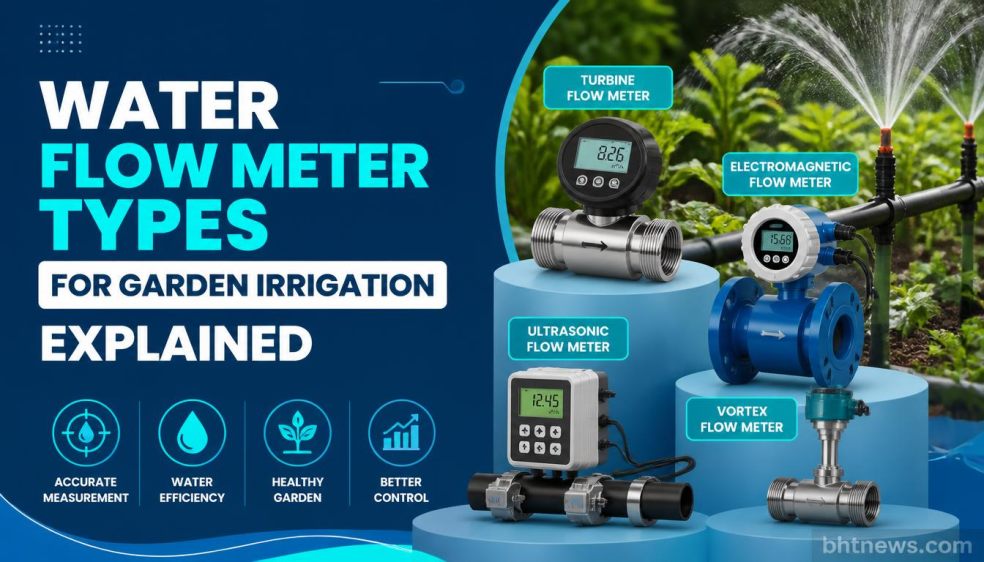
Engineers divide flow meters into five basic types, but only a couple are really worth considering for a garden.
This guide breaks down all five, shows which work for hoses, lawns, and irrigation lines, and walks you through setup and a simple bucket check for accuracy.
What’s a Water Flow Meter, and Why Does Your Garden Need One?
A water flow meter measures how fast water travels through a hose or pipe and how much total passes through. Usually, you’ll see rate as gallons per minute (GPM) and total volume as gallons or liters.
Engineering terms show up here: volumetric meters track volume over time, while mass flow meters measure mass—important for gases and fluids that change density. In gardens, water density hardly budges, so volumetric meters are all you need.
The numbers answer questions a timer can't:
- How many gallons does this sprinkler really use in 30 minutes?
- Is each drip zone getting its fair share?
- Did a worn hose washer or loose fitting waste water overnight?
- Is your lawn getting what you think, or only half?
For perspective, one inch over 1,000 square feet equals about 623 gallons. Not many people can eyeball that when they turn on the spigot.
For hose-fed beds, lawns, and sprinklers, the simplest way to start measuring is a hose-thread water flow meter that screws onto the spigot ahead of the hose.
RESTMO's collection, for example, lists 3/4-inch garden hose thread models that show total gallons or liters plus flow rate.
Its page states accuracy within about 5 percent and a minimum trigger flow of 0.3 GPM. Those are manufacturer figures, so confirm them with the bucket test in section 5.
The 5 Main Water Flow Meter Types (and Which Ones are Garden-Friendly)
These five types rule industrial plumbing, but garden use is simpler: clean tap water, modest flows, hoses or small pipes. That’s why just one or two types cover most yard needs.
A. Turbine and Paddle-Wheel Meters
- How it Works: Water spins a tiny rotor or paddle inside. Magnets or sensors count spins; electronics turn that into flow rate and volume.
- Best for: Clean, low-viscosity water—so most hose spigots and filtered irrigation lines.
- Pros: Low cost, simple, and accurate on clean water.
- Cons: Grit and debris can jam or damage the moving parts, and moving parts wear over time. Well or pond water needs a filter screen first.
Most inexpensive hose meters use this approach, and it's the right place to start for lawns and sprinklers.
B. Electromagnetic Flow Meters (Mag Meters)
- How it Works: They use Faraday’s Law: moving water through a magnetic field produces a voltage, which tracks flow.
- Best for: Well or pump discharge lines, bigger mainlines, or dirty water from ponds.
- Pros: No moving parts, less maintenance, hardly any pressure loss.
- Cons: They need power, cost much more than a hose meter, and can't measure non-conductive fluids like demineralized water. For a single hose, they're overkill.
C. Ultrasonic Flow Meters
- How it Works: Transit-time models send sound waves in both directions and compare timing. Doppler models bounce sound off bubbles or particles.
- Best for: Checking pump lines or buried mainlines without cutting pipe—just clamp the sensors to the outside.
- Pros: No pressure drop, and you don’t have to interrupt water.
- Cons: Pipe needs to be full, too many air bubbles can mess up transit-time readings, and clean pipes matter for good sensor contact.
D. Vortex Shedding Flow Meters
- How it Works: A bluff body sits in the stream, making water shed vortices. The meter counts how often that happens.
- Best for: High heat, steam, clean fluids at moderate to high flows.
- Garden fit: You’ll probably never need one—they work best at much higher flow rates than hoses or drip lines can handle.
E. Differential Pressure Meters (Orifice Plates and Venturis)
- How it Works: They measure the drop in pressure across an engineered obstruction. A bigger drop means faster flow.
- Best for: High-pressure industrial systems.
- Garden fit: Not practical. You might see venturi-style fertilizer injectors on irrigation, but those aren’t flow meters.
Engineering Comparison: Pick What Fits Your Watering Style
Here’s how the five stack up for yards. Check each model’s specs for details.
|
Meter type |
Typical garden fit |
Accuracy |
Dirty water |
Moving parts |
Relative cost |
|
Turbine / paddle-wheel |
Hose spigot, sprinkler zones, filtered drip lines |
Good on clean water |
Poor; add a filter |
Yes |
Low |
|
Electromagnetic |
Well or pump discharge, large mainlines, murky pond water |
Very good |
Good (water must conduct) |
No |
High |
|
Ultrasonic (transit-time or Doppler) |
Clamp-on check of an existing pump or buried line |
Good; pipe must be full |
Transit-time: clean water. Doppler: needs particles |
No |
Medium to high |
|
Vortex shedding |
Rarely used in gardens |
Good at moderate to high flow |
Fair |
No |
Medium to high |
|
Differential pressure |
Not practical for gardens |
Good at design flow |
Fair |
No |
Medium |
One note on accuracy numbers. Industrial paddle-wheel meters are commonly quoted around ±1 percent of full scale, according to Tameson's overview.
Low-cost hose meters are typically rated looser, so don't expect lab precision from a spigot-mounted model.
How to Match a Meter to Your Watering Setup
Start with what and how you water:
- Hose and sprinkler: Go with a turbine-style meter at the spigot. Cheapest, easiest, and it measures all water downstream.
- Drip irrigation: Make sure the meter actually reads low flows—many hose meters won’t pick up the slow drip rates (check the FAQ).
- Well, pond, or rainwater pump: Dirty water? Think electromagnetic or ultrasonic, or use a filter before a turbine meter.
- Buried mainlines feeding sprinklers: Clamp-on ultrasonic meters let you test without digging or cutting.
Four things to check before you buy:
- Flow range—your lowest and highest flows should fit inside the meter’s range.
- Connection—garden hoses use 3/4-inch hose thread (GHT), pipes use pipe threads (NPT) or clamp-on sensors. You’ll need adapters if they don’t match.
- Water quality—use a filter if the water carries grit.
- Display and power—battery LCD models are straightforward. Some brands offer Bluetooth or WiFi for tracking, and RESTMO has both.
Install and Calibrate: Best Practices
For hose-thread meters:
- Hand-tighten to the spigot; make sure the rubber washer sits flat. Overtightening cracks plastic.
- Follow the arrow or flow-direction mark.
- Keep displays out of direct sun—heat kills batteries and screens faster.
- Disconnect and drain before freezing temps. Frozen water cracks the housing.
For pipe-mounted or clamp-on meters:
- Straight runs: Too many elbows or valves create turbulence and inaccurate readings. Stick to about 10 pipe diameters of straight pipe upstream, 5 downstream, but always check your meter’s manual.
- Grounding and alignment: Electromagnetic meters need good grounding; ultrasonic sensors need proper spacing and clean surfaces.
Run a Bucket Test
Don't trust any meter blindly. This five-minute test shows how close yours is:
1. Zero the meter. Reset the total volume reading.
2. Fill a bucket. Use a marked 5-gallon bucket and run the hose at your normal flow.
3. Compare. Stop at the 5-gallon line and read the meter.
4. Repeat twice. If the readings agree, divide the true volume by the reading to get a correction factor.
Water Smarter With Your Meter
Once you’ve got numbers, the math is easy. To find out how many inches a sprinkler applies: divide gallons used by 0.623 times your area (in square feet).
Say you use 150 gallons in 30 minutes over a 400-square-foot patch—that’s roughly 0.6 inch. For a full inch, run it about 50 minutes.
Lawn water needs vary by climate, soil, and grass, so check your local extension office for exact targets.
Meters catch problems:
- Leak check: Turn everything off. If the meter still shows flow, you’ve got a leak.
- Zone comparison: If one zone uses way more or less water than others, check for broken heads or clogs.
- Weekly log: Write down totals for a few weeks—patterns pop out fast.
It pays off. The EPA says good irrigation management cuts water use about 15%, saving almost 7,600 gallons a year for a typical automatic system. A poorly maintained system can waste up to 25,000 gallons every year.
Conclusion: Pick the Right Meter for Your Yard
Quick summary:
- Of five main types, turbine or paddle-wheel meters suit most hoses and sprinklers.
- Electromagnetic and ultrasonic meters are good for pumps, wells, and big mainlines.
- Always check minimum flow before using a meter on drip lines.
- Run a bucket test; use the numbers to set run times and catch leaks.
Don’t overthink it. Pick one zone, meter it for a week, and see the difference between what you thought and what actually happened. Usually, that gap is your fastest water savings.
Frequently Asked Questions
Is a water flow meter really necessary for garden irrigation?
Not exactly. You can get by without one, but honestly, it's a lot easier with it. Without a meter, you're just guessing how much water each zone gets. Stick one on, and now you can set your run times based on real numbers, spot leaks, and actually see if your tweaks make a difference.
Which type works best for a garden hose?
Go for a hose-thread turbine or paddle-wheel meter. It screws right onto your standard spigot, doesn't cost much, and reads well — as long as your tap water's clean. Those fancier electromagnetic or ultrasonic meters are overkill; they're better for pumps and big mainlines.
Will a hose meter work on drip irrigation?
Eh, sometimes. Hose meters often need a minimum flow rate to kick in. RESTMO, for example, lists 0.3 gallons per minute for its meters. If you've got 20 one-gallon-per-hour emitters in a zone, that's about 0.33 GPM — just barely enough. Drop down to ten half-gallon-per-hour emitters, and you only get 0.08 GPM, way too low. Always check the minimum flow before relying on one for drip.
How to check your meter’s accuracy?
Try a bucket test. Fill a marked 5-gallon bucket, check what the meter reads, and compare it to the actual amount. Repeat the test a few times. If the results are off in the same way each round, use a correction factor to fix it.